
Impact & Benefits
Measurable change, not just a rating
Achieving a SKArating assessment results in a certificate – but the purpose of the system is far beyond that; it is about the outcomes it delivers: interior fit-outs that use fewer resources, cost less to run, and maintain their value for longer.
What SKArating delivers
- Real reductions in impact.
Lower energy and water consumption through better specification, controllability and operational setup – supporting Net Zero Carbon and circularity targets.
- Robust, credible reporting.
A quality-assured way to report sustainability impact and meet ESG requirements – with built-in protection against greenwashing, thanks to independent third-party Assessor audits.
- Systemic change.
Consistent good practice measures shift how design and delivery teams work, project after project – not just on the projects that get formally rated.
- More value, for longer.
Assets that retain value across multiple interior fit-out life cycles, and genuinely better spaces to work, shop or learn in.
- Reduced risk, delivered performance.
A shared knowledge base and clear benchmarks gives project and supply chain teams a consistent standard to work to, regardless of individual skills or experience – while clear targets keep performance on track through to the project’s completion.
- Recognised across the industry
SKArating good practice is referenced in, aligned with or integrated into the UK Net Zero Carbon Buildings Standard, the Energy Technology List, Government Property Standards, and guidance from BCO, AUDE, FIS, RIBA, CIBSE and RICS. It is also built directly into brand interior design concepts and corporate fit-out guides across the sector.
Benefits to Clients
- Robust, credible ESG reporting that aligns with emerging regulatory requirements and helps prevent greenwashing.
- Increased and retained asset value across multiple fit-out cycles or relocations.
- Clear guidance on good practice, reducing risk and rework during delivery.
- Alignment with the UN Sustainable Development Goals (SDGs), with the ability to prioritise the goals most relevant to your organisation.
- A single, coordinated suite of assessments — avoiding the double-counting and confusion that comes from stacking multiple sustainability labels.
Benefits to Assessors
- A license to audit, verify, and issue project certificates on SKArating’s behalf — a recognised, credentialed role within the industry.
- Access to the SKArating online tool for managing assessments, tracking projects, and issuing certificates efficiently.
- Standing as an accredited professional within a scheme used by major names across offices, retail, and higher education (e.g. Legal & General, Jaguar Land Rover, King’s College London).
Benefits to Competent Professionals (CPs)
- The opportunity to build recognised expertise in SKArating and sustainable fit-out delivery, distinct from (and complementary to) the Assessor license.
- A structured way to demonstrate sustainability knowledge to clients and project teams without needing to take on certification/audit responsibility.
- A clear route into the wider SKArating community and training pathway, with the option to progress further if desired.
Why SKArating Matters & The Real Impact of Sustainable Interior Fit-Outs & Refurbishments
Interior fit-out doesn’t get the attention whole buildings do
There’s no red-carpet moment when an interior fit-out goes in, no ribbon-cutting for a refresh. But interior fit-out is where a huge share of the built environment’s sustainability impact quietly accumulates — and where SKArating has spent the last 15+ years making a measurable difference, especially in the reduction of environmental impacts.
The scale problem nobody talks about
A typical building will go through an estimated 30 to 40 interior fit-outs over its lifetime. Whole-building certifications happen once but their interiors are fitted-out again, and again, and again — every time a tenant changes, every time a brand refreshes, every time a space gets reconfigured for how people actually work today, a change will take place.
That repetition is exactly why SKArating exists. When a SKArating pilot study was first commissioned back in 2005, the question was simple: could you actually measure the environmental impact of an interior fit-out project on its own terms, separate from the building it sits inside? The answer became SKArating in 2008 — and it’s been quietly reshaping how the industry thinks about interiors ever since. Nearly 20 years of quiet leadership have shaped how interior design is approached, how construction projects are delivered and how spaces operate during use.
The numbers behind the movement
Since 2011, over 12,000 interior fit-out or refurbishment projects have used SKArating to improve their sustainability performance, with over 1,230 of those being formally certified. Behind that headline figure sits a picture of an industry-wide tool at work:
- 10,300+ registered users of the free online tool, with 6,954 actively engaged as of 2026.
- 16 distinct market sectors represented in certified projects — from financial services and real estate to higher education, hospitality and legal.
- Every UK region reflecting certified projects, plus pilot projects in Ireland, Portugal, the USA, Brazil and Germany.
- 3 live schemes — Offices Environmental, Higher Education and Retail — with two Social & Wellbeing schemes in active development and Economic & Value in the plan.
Perhaps the most telling trend in the data is that a SKA Silver rating is now the most common certified project outcome, having overtaken Gold for the first time in recent years. That’s not a quality slip but an improvement following management decisions and our quality assurance framework being implemented. It’s what it looks like when a scheme moves from being an early-adopter’s badge of honour to a mainstream industry expectation. More projects, more organisations, more of the supply chain — all showing up, not just the sustainability leaders who were always going to turn up anyway.
Certification Ratings Overview from 2024 onwards

Figure 1. Rating mix by year, based on Date Submitted. The three-year shift from Gold-majority to Silver-majority is the clearest trend in the dataset.
Client Market Sectors
Recent clients allocated to a market sector based on general knowledge of each organisation.

What good practice actually looks like
Numbers only tell half the story. The real proof is in what happens on individual projects — and examples of recent certified projects, in very different sectors, show exactly how much ground SKArating covers. Read the case studies below to get insights and be inspired to use the schemes and deliver value on your projects.
Through the numerous projects and case studies seen, it is clear that SKArating works not just across sectors and levels of ambition, but across building types too, including historic buildings or fast paced project deliveries and ambitious base-build landlord requirements where sustainability is often assumed to be hardest.

Wagamama, Clarks Village: sustainability as a team sport
Wagamama’s fit-out at Clarks Village achieved SKArating Gold and became the subject of one of our recent podcast episodes. Alex Neil, Wagamama’s Group Head of Construction, and Stewart Muir, Senior Technical Consultant at Bioregional, walked through what the project’s assessment and certificate achievement, actually took:
- 14–20% energy reduction, achieved simply through better monitoring — proof that a lot of impact sits in operational discipline, not just specification choices
- A 50% rise in water costs that turned out to be one of the most valuable data points in the whole project, because it forced the team to take real-time monitoring seriously
- Circularity built in from the start — recycled chopsticks, ocean-waste plastic chairs, and furniture reuse, rather than sustainability bolted on at the end
- A genuine shift in how the delivery team worked together, with both Neil and Muir describing achieving Gold as “a team sport.”
That last point matters more than it might sound. SKArating’s Good Practice Measures aren’t just a scorecard — they’re designed to create a shared reference point across designers, contractors and clients who don’t always speak the same technical language. When a project team is working from the same 100+ measures, covering everything from embodied carbon to wellbeing, the guesswork drops out of what “doing it properly” actually means.
Read the full case study here.

Eden, Manchester: a UK first, delivered at pace
At Eden, New Bailey in Salford, contractor Overbury delivered the UK’s first fit-out to achieve both SKA V2 Gold and Net Zero Aligned certification, in March 2026 — proof that the scheme’s newer, more rigorous v2.0 standard is deliverable in practice, not just on paper.
- A 5,134 sq ft plug-and-play office suite delivered in just 6 weeks, showing that outcomes-based, higher-bar certification doesn’t have to slow projects down.
- Circularity by design — demountable furniture systems and minimised partitions cut embodied carbon while keeping the space adaptable for future tenants.
- Delivered as the first occupier-ready suite within one of the UK’s most sustainable office developments, alongside tenants already at Eden.
Where Wagamama shows what SKArating looks like in a fast-paced hospitality fit-out, Eden shows what it looks like at the leading edge of the scheme’s own standards — the two together make the case that SKArating works across sectors, project sizes and levels of ambition.
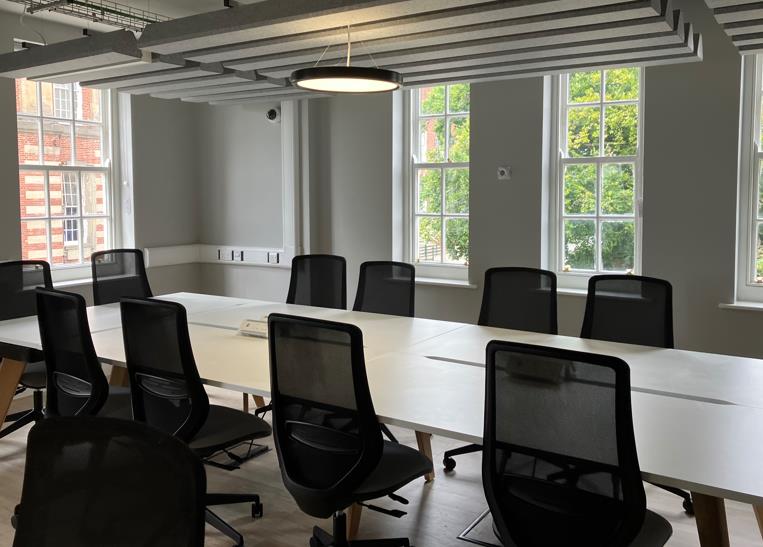
Leeds Beckett University, Caedmon Hall: heritage is no barrier to Gold
Leeds Beckett University’s refurbishment of Caedmon Hall, a Grade II listed teaching and office building on its Headingley Campus, achieved SKArating Gold under the Higher Education v1.0 scheme. With single-glazed timber windows, gas boilers and strict limits on what could be changed, the project shows how much a historic building can still deliver when sustainability is assessed holistically rather than through carbon alone.
- Low-carbon heating in a listed shell: an air source heat pump now serves the heating circuits, backed by LED lighting with presence detection and a new BMS with sub-metering by floor, water and heat.
- Low-cost behavioural measures where fabric upgrades were restricted, including a closed-door policy supported by automatic entrance doors and insulating blinds.
- Impact beyond energy: local apprenticeships, locally sourced materials and labour, FSC-certified timber throughout, and furniture and IT schedules so items can be reused across the University estate.
- An assessment kept honest: 66 items of evidence recorded on site, and when a late change of paint supplier meant one measure could no longer be met, it was removed from target rather than claimed.
The process mattered as much as the outcome. University staff, quantity surveyors, engineers and interior designers each owned specific measures, and with the SKArating Assessor coordinating the team through the SKArating online tool. The University’s main lesson was to bring SKArating into design conversations from the earliest stages, and it plans to do exactly that on future projects.
Read the full case study here.
Through the numerous projects and case studies seen, it is clear that SKArating works not just across sectors and levels of ambition, but across building types too, including historic buildings or fast paced project deliveries and ambitious base-build landlord requirements where sustainability is often assumed to be hardest.
Why this matters beyond any single project
Three things make SKArating’s impact bigger than the sum of its certificates:
It’s free at the point of entry.
The tool itself costs nothing to use — organisations only pay if they want formal, quality-assured certification. That single decision has kept the barrier to entry low across the whole supply chain, from major consultancies down to smaller contractors who’d never justify a costly accreditation scheme. We welcome and host thousands of assessments on the online tool and make the Good Practice measures freely available. Many projects start slowly with change by learning how to use a scheme before proceeding to certification.
It’s tightening, not loosening.
The embodied carbon benchmarks included in the Offices Environmental 2.0 scheme get lower on a published timeline — 250 kgCO2e/m² in 2024, down to 195 by 2027, with further reductions targeted for 2030 and in line with the other industry standards such as the UK Net Zero Carbon Buildings Standard. Rather than resting on what “good” looked like a decade ago, the scheme is actively raising the bar as the industry’s own capability improves and offers a harmonised solution across standards.
It’s independently audited.
Every formal certification goes through a third-party Assessor audit, not a self-graded checklist. In an era where “greenwashing” has become a genuine reputational risk, that audit trail is exactly what gives SKArating certification its credibility with clients, investors and regulators alike. Our Quality Assurance framework provides a system of review, audit, improvement and feed-back loops that look to balance the robustness of formal assessments with the adjustability needed for innovative change.
Geographic Analysis including historic data
Regions were inferred from the county/postcode segment of each project’s address.

Figure 8. Certificates by geographic area, log scale. Navy = UK regions, red = international, purple = the UK’s historic total as of Jan 2024 (1,001, not regionally attributable). London alone accounts for over half of this workbook’s geolocated certificates.

Figure 9. Schematic UK map with red circles sized by certificate count per region. The large purple circle spans the whole map deliberately, to represent the UK’s pre-2024 historic total (1,001 certifications, 2011–2023) — shown for scale, not attributable to any region. International certificates (Ireland, Portugal, USA, Brazil, Germany, France etc) are listed separately since they fall far outside the UK map frame.
The bigger picture
The sustainability of interior fit-out and refurbishments will unlikely generate the same headlines as a landmark net-zero tower might. But given how often interior fit-out and refurbishments happen — and how much of the built environment’s day-to-day carbon footprint and resources are used by and sit inside those repeated cycles of strip-out and refit — it may well be one of the highest-leverage places the industry and nation can focus its attention.
SKArating’s own data reflects this: a market broadening beyond early adopters, a growing international footprint, the addition of the new sustainability impact pillars, and familiar individual projects like Wagamama’s, Leeds Beckett University’s, and Eden’s case studies proving that the numbers translate into real operational savings and deliverable, rigorous quality assessments and not just certificates on a wall.
If you work in design, construction, procurement or facilities and haven’t looked at SKArating in detail yet, the tool is free to try, as is also the introduction to SKArating training session where you can register and learn. And if your organisation is interested in supporting the next stage of SKArating’s growth where we’re looking to double our impact, as a Partner or sponsor, we’d love to hear from you.
Register and try the SKArating online tool – link here.
Find out about how to procure a SKArating Assessment – contact an Assessor from our Directory.
Wish to support our work and find out about becoming a Partner? Email us at support@skarating.org or visit the Partners page.