

SKA rating News | AP Community Event
FUTURE PROOF: What We Learned at the SKArating AP Community Event
On Thursday 12 November 2026, the SKArating Accredited Professional community came together in person at Somerset House in London for FUTURE PROOF: an afternoon on the changing role of SKArating professionals. It was our first in-person AP community event in a few years, and the room showed why that mattered.
Assessors, contractors, designers, manufacturers and waste specialists swapped screens for handshakes. When we surveyed the accredited community, you told us you wanted to meet face to face, so we made it happen. Here is what we covered, and what we’re taking away.
Welcome and Future View: Bronze is the New Gold
Elina Grigoriou, Director of Grigoriou Interiors and member of the SKArating Governance Board, opened with where SKArating has got to and where it is heading. Since the scheme moved to its own home from RICS in 2023, the Board has worked to three aims: a true triple bottom line assessment covering environmental, social and economic impact; expansion into more sectors and countries; and reaching deeper and earlier into the life cycle of a space.
The numbers tell a story of a scheme going mainstream:
| Measure | Figure |
|---|---|
| Projects that have used SKArating since 2011 | 12,000+ |
| Projects formally certified | 1,230+ |
| Registered users of the free online tool | 10,300+ |
| Market sectors with certified projects | 16 |
| Countries beyond the UK with pilot assessments | 6 |
The headline trend surprised some: Silver has overtaken Gold as the most common certified outcome. Elina was clear this is not a quality slip. More teams who are new to sustainability are now using SKArating, the quality assurance framework has tightened, and updated schemes are always harder than the ones they replace. Her message to Assessors was to take back to clients: Bronze is the new Gold. A Bronze is a legitimate, hard-won achievement.
The bar will keep rising too. Embodied carbon benchmarks in SKArating Offices Environmental v2.0 fall from 250 kgCO2e/m² in 2024 to 195 kgCO2e/m² by 2027, in line with the UK Net Zero Carbon Buildings Standard. Those benchmarks will extend to other sectors over time.
Looking ahead, Elina named the two bottlenecks the market keeps raising: the heavy process load of sustainability work, and the complexity of explaining it to clients. The Board’s response is to embed the value pillar of the triple bottom line, use technology to cut the cost of evidence collection, and support Assessors to upskill, so they can spend more time adding real value, on more projects. The ambition is bold: every project that goes through Building Regulations approval should also undertake a sustainability assessment using SKArating.
Case study: Eden, the UK’s first Net Zero aligned certificate
Vicky Dootson, Sustainability Manager at Overbury (Morgan Sindall Fit-Out Northern), gave a refreshingly practical account of the first fit-out certified under SKArating Offices Environmental v2.0. The project, a speculative plug-and-play suite in Muse Developments’ Eden building in Salford, achieved Gold and Net Zero aligned status. Assessor Walid Nadar of Verte joined her in the room.
The client first asked for BREEAM. A sustainability workshop revealed what they actually cared about: low embodied carbon, circularity and a fit-out the next tenant could easily change. That pointed to SKArating Offices Environmental v2.0. Vicky’s first lesson was simple: sit with the client and listen before defaulting to a scheme.
At 477 m², the project was a manageable size for a first run at a new assessment scheme. The timescale was not: just four weeks of design and six on site. So the team contracted for Silver and strived for Gold, landing 45 measures against the 40 needed. What made the difference:
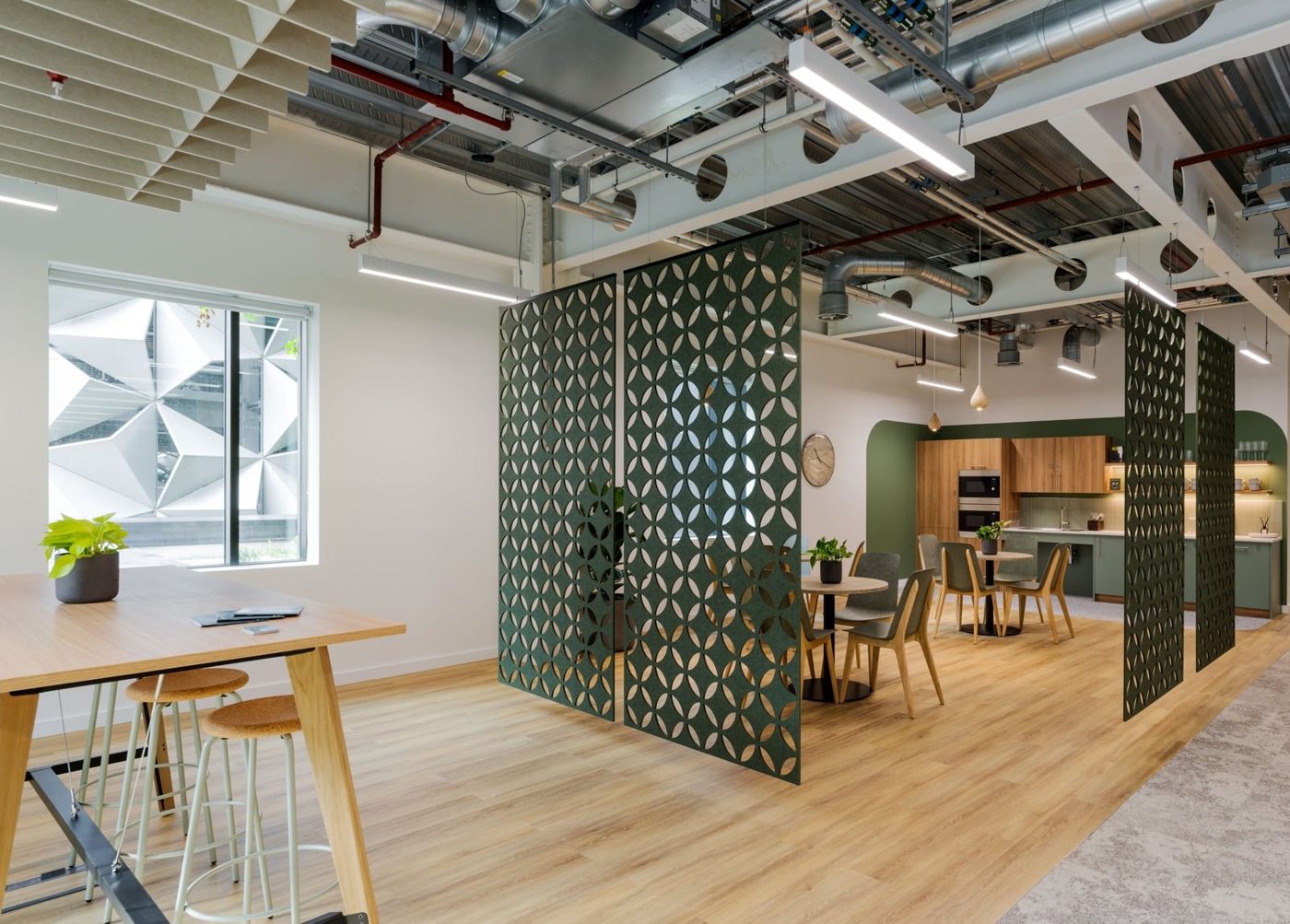
- Minimal build. Only two meeting rooms, two focus rooms and one wall were fixed construction. Everything else used demountable joinery screens and acoustic panels.
- No glue. Slatted screens slot over metal poles through the raised floor. Acoustic panels use a mechanical fixing system, and even worktop lengths were set to avoid gluing.
- Total Cat A reuse. All lighting, fan coil units, ductwork, doors, controls and raised access flooring stayed, so there was no Cat A waste.
- A designer-friendly spreadsheet. The finishes schedule became a yes/no flow chart for checking materials against the criteria, which then doubled as the Assessor’s evidence tracker.
The proof came the week of the event. A new tenant moved in and the screens were taken down in minutes and reused in phase two, exactly as designed. Vicky didn’t get a chance to record it as the disassembly and re-planning happened so quickly.
Vicky was candid about the hard parts. Four weeks of design was too short, and around 90% of the work sits in the design stage. Disassembly guides and Product Circularity Data Sheets (PCDS) rarely exist at the moment, so she wrote many herself. Next time, subcontractors will be asked to price for them at tender. The good news: there was no noticeable cost uplift beyond time, the client found the guides genuinely useful, and with templates now in place, phase two is running far more smoothly.
Vicky said several processes introduced by the new scheme, notably the Resource Management Plan and Tracker (RMPT), have become part of how she works on every project, because she has seen their value.
In the Q&A, the room asked about manufacturer data and the ability to have a list of recognised SKArating compliant manufacturers. Elina noted that SKArating already offers a product directory and a SKA-compliant product label, and urged manufacturers to make use of them.
Panel: The Future Is Circular
Dave Wakelin, Head of Sustainability and Net Zero at Liverpool City Council and SKArating Board member, chaired a panel spanning the supply chain: James Ivin (Overbury and Morgan Lovell), Tim Bowes (Whitecroft Lighting) and Dave Wolfenden (KM Eco). The conclusion was striking: circularity is less about products than about process, timing and relationships.
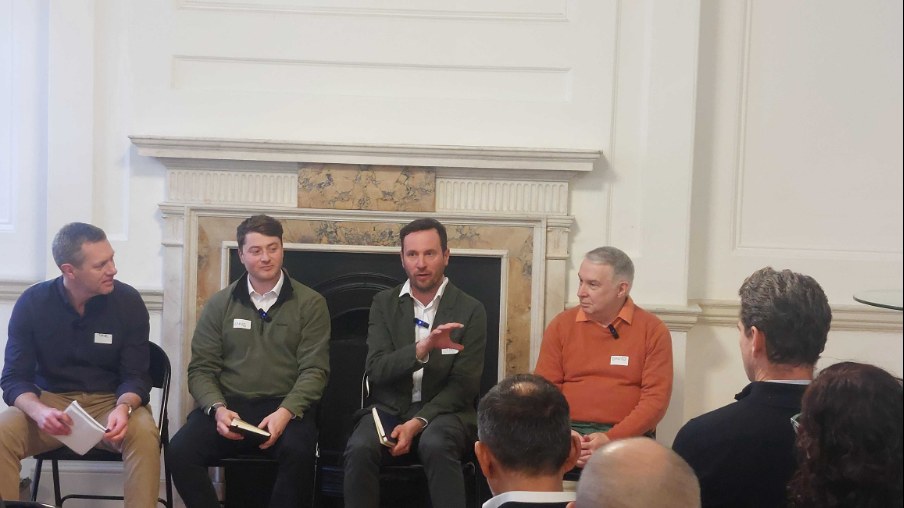
The barriers. Every panellist named timing first. Waste and reuse specialists are brought in too late to plan what comes out of a building as carefully as what goes in. Dave Wolfenden added that the recycling industry is currently absorbed by new legislation, including waste tracking, which is slowing innovation. Tim described a linear chain that keeps manufacturers several steps away from clients and prevents circular solutions getting traction. Whitecroft can lease or take back luminaires, but rarely gets to speak to the client who asked for these.
What is working. Tim and James shared how around 250 barely used light fittings from one Overbury project were recertified and reinstalled on another within six months. KM Eco is running closed-loop schemes with British Gypsum for plasterboard, with glass reprocessed at Tilbury, and with recycled floor protection. Whitecroft’s switch to reusable packaging turned into a site logistics win, with asset-tagged boxes delivered straight to installation zones.
What needs to change. James called for estimators and contract managers to build time for demounting into packages from the start. Tim argued the relationship must continue for years after handover, so that good products are recovered rather than skipped. Dave asked designers to avoid bonded materials that cannot be separated for recycling.
An audience question about the emotional connection to materials struck a chord. Reused items with a story, like the reclaimed basketball court floor in Eden’s reception, can engage occupants in a way new products cannot. Schools, Tim noted, are especially excited by these stories. The panel’s closing thought: the SKArating Offices Environmental v2.0 criteria already drive the right circularity behaviours, so the simplest answer is to use them.
Panel: Adapting and Thriving in an AI and Technology Driven World
Elina returned to chair the second panel with Katherine Adams (Reusefully), Gilbert Lennox-King (Construction Carbon) and Anastasia Stella (Circuland). She framed the challenge directly. The Board is working to connect the online tool to data platforms such as EPD and pre-loved databases, removing much of the evidence-chasing that fills an Assessor’s day and constricts the value delivered. Once technology is integrated and handles that legwork, what is the sustainability professional’s role and value?
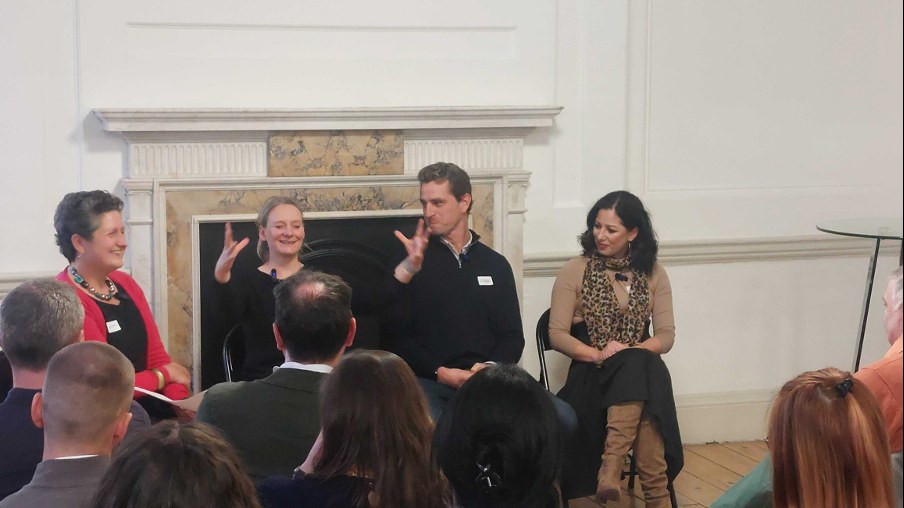
A rapid-fire opening round set the tone. Asked to name the greatest sustainability tool, nobody chose software. The answers were humans, influence and transparency.
Each panellist described what success with AI would look like in their own work:
- Katherine leads a nine-person team that carries out resource audits, from small refurbishments to whole town centres. Its new AI-enabled platform should free auditors from number-crunching to focus on rehoming materials.
- Gilbert works on life cycle assessments and EPDs. He wants AI to bring consistency to LCA results, which can vary widely, and to cut the paperwork nobody entered sustainability to do.
- Anastasia builds product passports linked to models and drawings. AI extracts data from existing manufacturer documents, cites the source and flags numbers that look wrong.
The bottlenecks were just as candid. Katherine wants to see through walls during audits, and to match reclaimed materials with people who need them. Gilbert pointed out that most tenants still do not demand net zero buildings, leaving viability as the real constraint. Elina added a designer’s view: AI-generated imagery could make pre-loved products look as desirable as new ones, rather than photos in a warehouse.
The message for Assessors was positive. Technology should take away the hamster wheel of data collection, leaving more time for the advice that changes outcomes.
What we’re taking away
The afternoon continued with breakout groups, where experienced professionals shared the one practical thing they wish they had known when starting out. Joe Croft of Overbury and the SKArating Board then led an open discussion on changing client demands, before Elina wrapped up and the conversation carried on at The Wellington across the road.
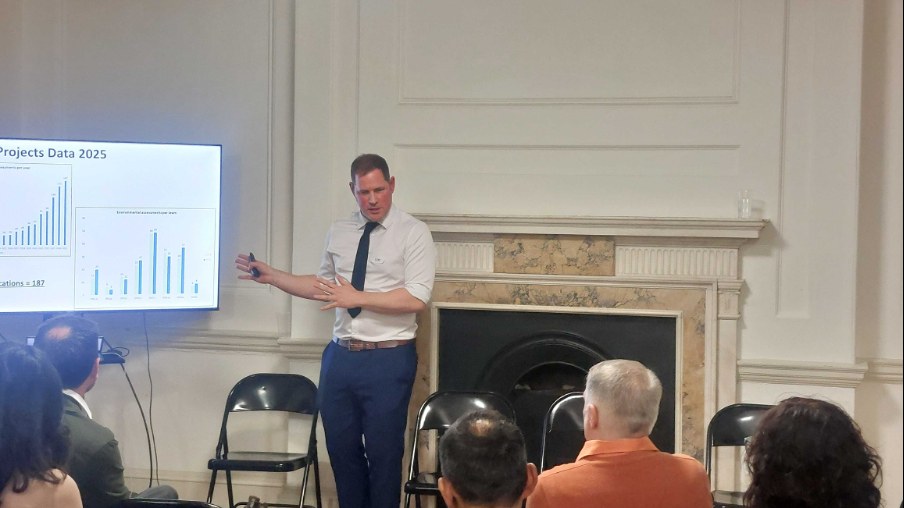
In the open discussion, the room agreed that client demand for sustainability is holding steady: at least a third of projects undertake one or more sustainability assessments.
Four threads ran through the whole day:
- Every rating counts. As SKArating goes mainstream, Bronze and Silver are real achievements, and Assessors are the best people to communicate this to clients and teams.
- Design stage is everything. From Eden to the circularity panel, the message was to engage early, plan time for it and agree responsibilities at tender.
- Circularity is a system. Products only stay in use when designers, contractors, manufacturers, waste/resource partners and clients keep talking beyond handover.
- Technology should free people up. Less time chasing evidence means more time on the advice that changes projects.
What attendees told us
“Really powerful, insightful, informative and lots of fun” was how one attendee described the afternoon. Another told us: “I go to a lot of events, but genuinely I have been impressed! Need to do more re SKA!” The response was overwhelmingly positive, and the day clearly struck a chord.
That face-to-face time is what many of you valued most. “It was great to attend an in-person event! Would love more,” said one attendee. Many of you valued the “village” feel of the day and the chance to talk issues through in small groups, with one finding it “really useful to hear other opinions/challenges”. Others summed it up as a “passionate event” and simply asked for “more brainstorming like this!”
There was a clear appetite for more, with many keen to keep the conversation going and help spread the word about SKArating. Every respondent said they’d be likely to join a similar event again, and we’ll be taking all ideas on board as we think about how the community comes together in 2027.
Thank you to everyone who came, to our speakers and panellists, and to our event sponsor Overbury, our Gold Partners SAS International and KM Eco, and our Silver Partner Burmatex. Slides are available in the online course session for registered attendees.
Showcase Your Projects
Have a project you’re proud of? We want to share more real case studies from the community, so get in touch through SKArating.org. Watch this space for the full case study and short videos from the Eden project showing how the demountable systems come apart.